Smart Pharma Design and Engineering Execution Solutions
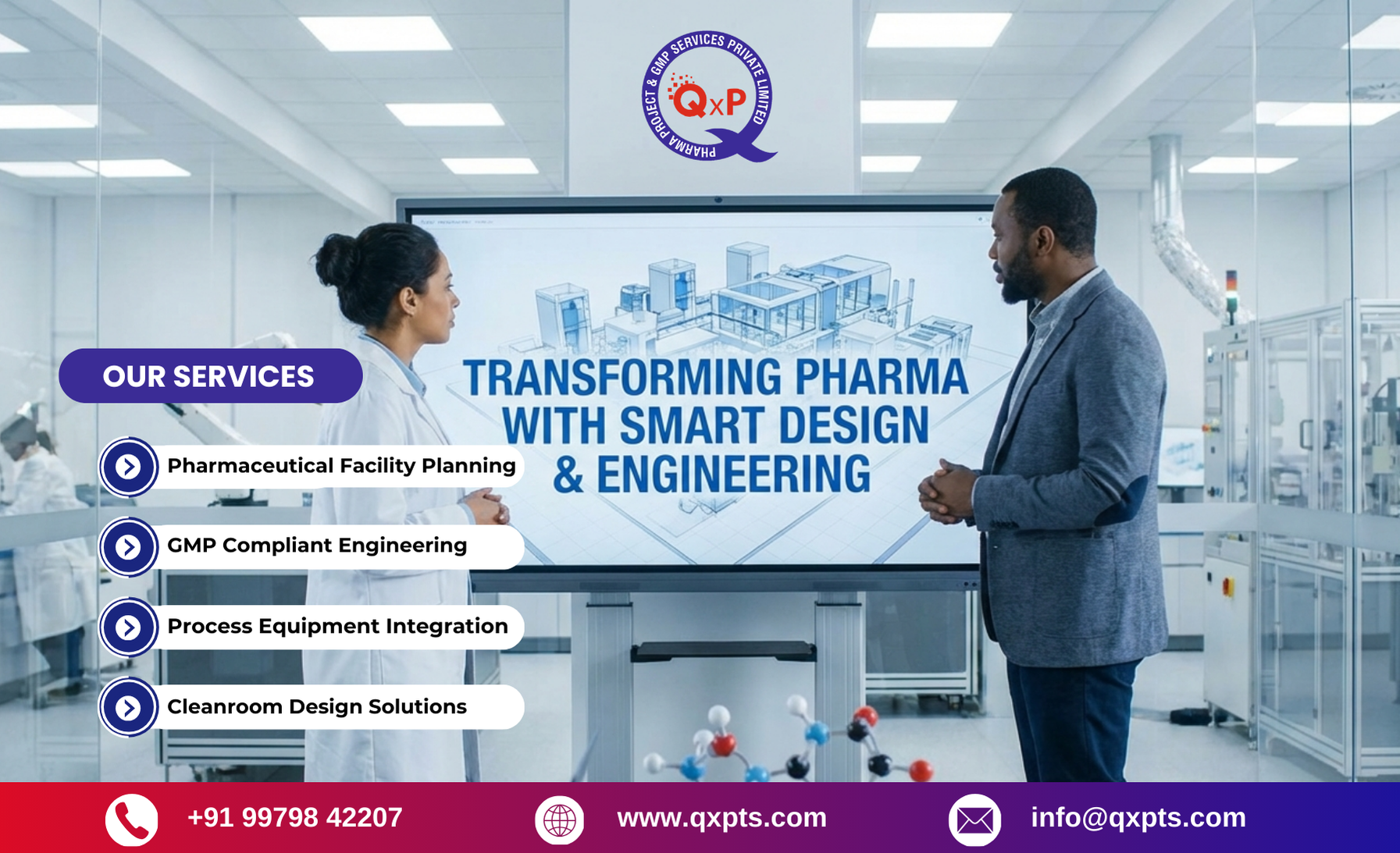
Transforming Pharma Infrastructure with QxP Pharma Consultant & GMP Services
Smart Pharma Design and Engineering Execution Solutions are redefining how pharmaceutical infrastructure is planned, built, and validated in today’s highly regulated healthcare landscape. In the global pharmaceutical and healthcare environment, safety and compliance are no longer optional — they are operational imperatives. From manufacturing plants in India and sterile facilities in the United Arab Emirates to hospital infrastructure projects in Saudi Arabia and advanced biotech sites across the United States and Europe, organizations face mounting pressure to safeguard personnel, control machinery risks, clear regulatory audits, and fulfill strict legal obligations.
Current industrial settings present much greater complexity than in the past. Automation installations, fast-paced manufacturing equipment, building climate control engineering, sterile area validation methods, and international governing oversight necessitate more than standard project administration. They demand carefully planned, technically sound implementation backed by thorough safety knowledge and awareness of regulations.
This is the point where a Pharma Design and Engineering Execution Specialist becomes essential — not just as a guiding advisor, but as an involved partner in bringing things to fruition. With hands-on background spanning varied locations such as Qatar, Oman, Canada, the UK, Australia, South Asia, Tajikistan, and Afghanistan, such experts connect engineering exactness with regulatory requirements and workforce well-being to guarantee successful, rule-abiding project completion.
Increasing Significance of Safety & Adherence in Worldwide Sectors
Over the last decade, the rules governing operations have broadened considerably. Governments are intensifying their review processes. Clients are asking for greater openness regarding adherence. Insurance underwriters are increasingly tying premium costs to safety performance records.
In India, evolving industrial demands have elevated the required standard for plant layout and staff welfare. In the Middle East, rapidly expanding infrastructure has increased the responsibility placed on contractors.
At global project sites, one pattern is persistently visible:
- Enterprises that incorporate safety considerations throughout the design and engineering phases encounter fewer operational interruptions down the line.
- Meeting standards nowadays is not solely about passing an inspection. It involves demonstrating a systematic control of hazards from the initial drawing phase through to handover.
What Exactly Is a Pharma Design and Engineering Execution Specialist?
A Pharma Design and Engineering Execution Specialist is a specialist professional or organization that guarantees pharmaceutical facilities are formulated, engineered, and realized in compliance with safety, Good Manufacturing Practice (GMP), and regulatory expectations.
In practical terms, this involves:
- Examining facility layouts for safe paths and material transit
- Confirming sterile zone classifications match intended output
- Verifying that equipment setup adheres to safety codes
- Monitoring utility systems (HVAC, pressurized air, water networks) for conformity
- Supplying the paperwork needed for official reviews and accreditations
This function is not confined to India. When pharmaceutical ventures are underway in the UAE or Saudi Arabia, specialists must grasp contractor safety practices. In Canada or the UK, control over records and proof of validation are intensely scrutinized. In South/Southeast Asia or developing areas like Tajikistan and Afghanistan, infrastructure challenges call for flexible engineering approaches.
Frequent Safety & Compliance Difficulties Across Nations
Despite regional variations, several safety challenges are common everywhere:
- Staff Injuries: Poorly arranged equipment setups, insufficient machine shielding, inadequate air exchange, and unsafe material handling arrangements lead to incidents.
- Machinery & Project Dangers: Unverified automation setups, pressure containers, high-power electrical installations, and poorly managed construction stages increase operational exposure.
- Legal Sanctions & Halts: Failure to comply can result in fines, facility closures, product retrievals, or contract termination. In strictly governed areas like the US or Europe, damage to reputation can last a long time.
In international assignments, we have witnessed projects stall not due to technical failure — but because safety documentation was incomplete or adherence by contractors was uneven.
How Does Professional Safety Credentialing Lower Risk?
Professional safety accreditation and methodical execution decrease unpredictability.
This encompasses:
- Detailed facility checks during design and implementation stages
- Hazard reviews prior to equipment startup
- Matching facility arrangement with GMP zoning concepts
- Paperwork consistent with both local and international benchmarks
- Organized reporting mechanisms to be prepared for audits
A competent specialist doesn’t just spot issues. They put in place corrective mechanisms that forestall repetition.
The goal is dependable compliance — not responding to problems after they occur.
Region-Specific Adherence Nuances
While universal principles apply universally, subtle regional variations in regulatory compliance are important.
- India: Factory operations must harmonize with industrial safety laws and expectations for employee welfare. Authorities increasingly anticipate documented hazard assessments, compliance in machine safety, and environmental management. Upholding GMP rules remains central for pharma sites.
- Middle East (UAE, Saudi Arabia, Qatar, Oman): The fast pace of industrial growth has reinforced the enforcement of site safety and contractor accountability. Engineering tasks require strict permit systems, equipment proof of conformity, and oversight of workforce safety.
- Europe & USA: The culture of official review is deeply ingrained. Accuracy of documentation, validation evidence, and tracking systems face intense examination. Facilities must demonstrate sustained adherence, not just readiness at certain times.
- Australia & Canada: The emphasis on worker safety is strong, and regulating bodies prioritize preventative structures over remedial actions.
- South/Southeast Asia & Nascent Regions: The condition of infrastructure differs widely. Specialists need to tailor engineering methods while upholding global compliance standards.
A consultant with worldwide experience comprehends these differences and incorporates them into project execution planning.
Worker Education & On-Site Safety Execution
Safety frameworks falter without adequately trained personnel.
In worldwide projects, the labor pool often speaks different languages. In the Gulf states, teams might comprise staff from South Asia, Southeast Asia, and Africa.
Effective safety deployment involves:
- Unambiguous safety directions in various languages
- Visual Standard Operating Procedures (SOPs) for equipment use
- Brief safety meetings during construction phases
- Live demonstrations over purely theoretical instruction
- Sensitivity to cultural norms in exchanges
Safety culture cannot simply be delivered; it must be cultivated within the existing workforce setting.
Machinery, Apparatus & Project Safety (Worldwide Viewpoint)
Pharmaceutical ventures typically feature high-risk elements:
- Manufacturing Systems
- Sterile area pressure differentials
- Sterilization mechanisms
- Chemical storage zones
- Automation and control system integration
- Building & Refurbishment Projects
Function of Safety Reviews, Reporting & Paperwork
Reviews are not merely procedural hurdles. They reflect the maturity of operations.
Safety evaluations might be carried out by:
- Government bodies
- International clientele
- Accreditation agencies
- Insurance providers
Lasting Business Advantage of Global Safety Certification
Safety is often viewed as an expense. In reality, it preserves business continuity.
Long-term upsides include:
- Fewer workplace mishaps
- Lowered legal exposure
- Consistent project schedules
- Enhanced client confidence
- Better standing with insurers
- Smoother access to regulated markets
As pharmaceutical firms expand from India into the Middle East or North America, organized safety structures support international standing.
Investors and collaborators seek proof of operational toughness — beyond just production capacity.
What to Assess Before Selecting a Safety Certification Partner?
Choosing the appropriate collaborator is a strategic choice.
Examine:
- Global Background – Have they managed projects spanning borders?
- Familiarity with Local Rules – Do they grasp how local enforcement operates?
- Practical Implementation Skills – Can they supervise field activities, not just draft documents?
- Documentation Proficiency – Are systems prepared for audit scrutiny?
- Sector-Specific Insight – Pharmaceutical design differs from general manufacturing.
A capable specialist should be comfortable both on the building site and during an official review.
Why Partnering with a Globally Focused Safety Firm Matters?
Global activities require uniformity.
An approach that is standardized yet adapted regionally secures:
- Consistent safety levels across multiple sites
- Adjustments for local workforce realities
- Ongoing adherence monitoring
- Support for structured engineering execution
Businesses operating across India, the UAE, Europe, or Southeast Asia benefit from partners who understand both global best practices and the situation on the ground.
For corporations aiming for structured, compliance-driven engineering implementation, QXP Pharma Project Consultant & GMP Service PVT LTD offers integrated support that aligns with international benchmarks and practical field setup experience.
Discover more at: https://www.qxpts.com/
Summary:
Industrial safety and adherence are no longer isolated regional duties — they are worldwide obligations.
From pharmaceutical production plants in India to hospital construction tasks in Saudi Arabia, from regulated biotech centers in Canada to growing industrial activities in Southeast Asia, organizations share a single common duty: safeguarding employees while ensuring seamless, compliant workflows.
A qualified Pharma Design and Engineering Execution Specialist assists in turning safety from a mandated obligation into an operational asset.
Enterprises that weave safety into their design and execution now will move forward with assurance later.
Main Points to Note
- Staff Well-being must be integrated during design, not post-startup
- Legal & International Conformity demands consistent documentation
- Hazard Mitigation starts with organized engineering implementation
- Global Operational Trust hinges on proactive safety measures
Frequently Asked Questions (FAQs)
1. What does a Pharma Design and Engineering Execution Consultant actually do?
- They ensure pharmaceutical facilities are designed and executed in compliance with safety, GMP, and regulatory standards, while managing practical on-site risks.
2. Is compliance different in India compared to the UAE or USA?
- Yes. While core safety principles are similar, enforcement intensity, documentation requirements, and contractor compliance expectations vary significantly.
3. Why is documentation so important in Europe and North America?
- Regulatory authorities emphasize traceability, validation evidence, and consistent record-keeping as proof of operational control.
4. Can safety certification reduce insurance premiums?
- In many cases, structured safety systems and lower incident history positively influence insurance assessments.
5. When should safety consultation begin in a pharma project?
- Ideally during conceptual design. Early integration prevents costly redesigns and compliance gaps.
#PharmaDesign #EngineeringExecution #GlobalCompliance #IndustrialSafety #GMPStandards #PharmaConsultant #WorkerSafety #AuditReady #HospitalInfrastructure #QXPPharma #InternationalProjects


Comments
Post a Comment