Turnkey Project Experts for Seamless Industrial Delivery
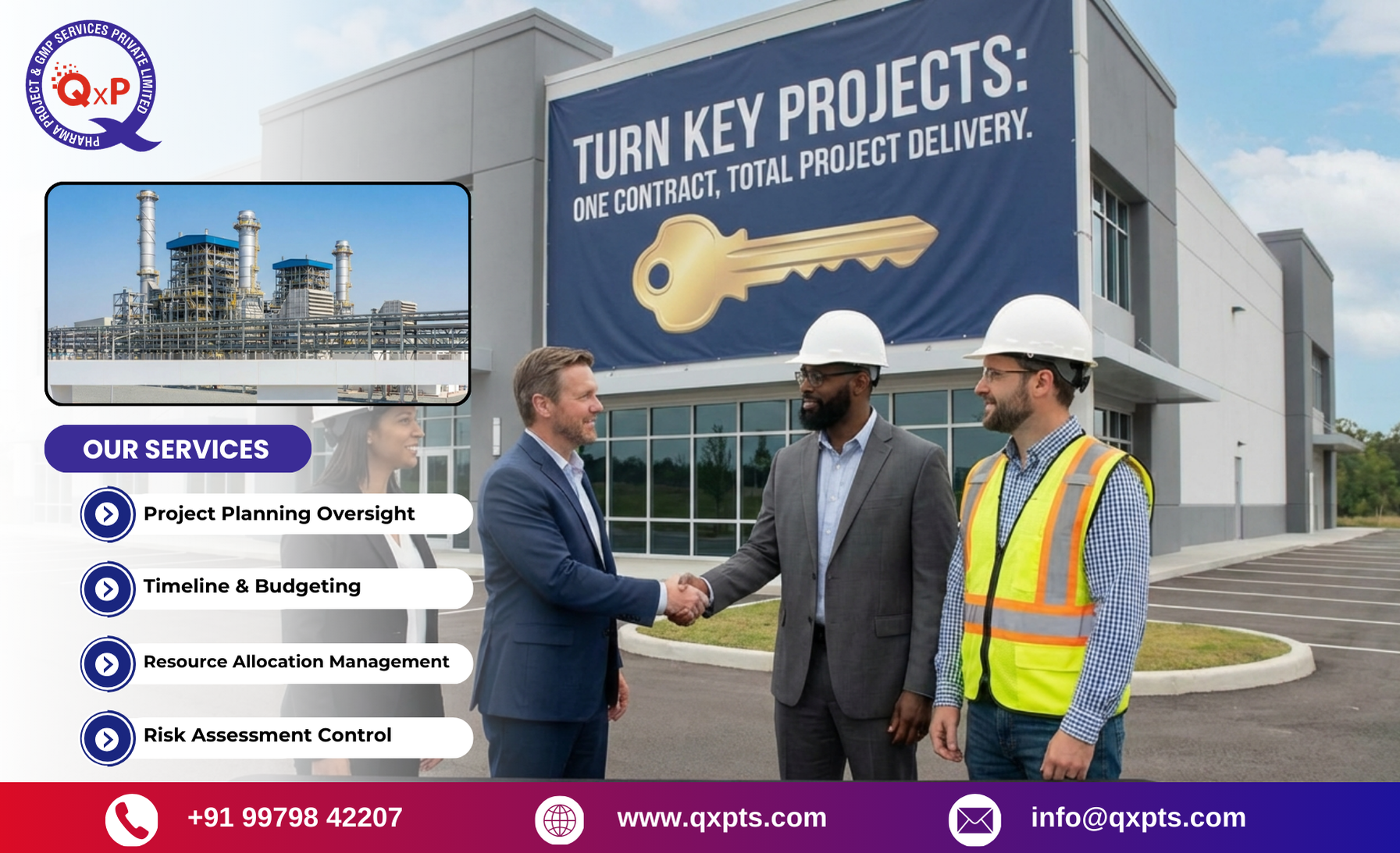
End-to-End Turnkey Project Execution by QxP Pharma Consultant and GMP Services
Turnkey Project Experts for Seamless Industrial Delivery are increasingly vital in today’s interconnected industrial landscape. Organizations face growing pressure to execute complex facilities safely, on schedule, and in full regulatory compliance. From pharmaceutical manufacturing plants in India to hospital infrastructure developments in the United Arab Emirates, energy projects in Saudi Arabia, and advanced manufacturing hubs across Europe, leadership teams must simultaneously manage worker safety, machinery risks, environmental obligations, regulatory audits, and legal accountability.
Even a minor oversight can result in workplace incidents, compliance penalties, costly delays, or long-term reputational damage. For CEOs, CFOs, Project Directors, Engineering Leaders, and Safety Officers, the margin for error is minimal. Operational continuity, investor confidence, and stakeholder trust all depend on embedding safety and compliance into projects from the very beginning.
This is why partnering with a Pharma Turnkey Project Consultant is no longer a strategic luxury but a practical necessity. These specialists integrate design, procurement, construction, validation, and regulatory compliance into a unified execution framework—ensuring safety, quality, and compliance are engineered into every stage of the project lifecycle rather than addressed reactively.
Growing Importance of Safety & Compliance in Global Industries
Industrial regulations are tightening worldwide. Authorities in India, the Gulf region, Europe, North America, and Australia increasingly expect organizations to demonstrate proactive risk management, not just reactive compliance.
Several forces are driving this shift:
- Expansion of multinational operations across borders
- Heightened worker safety expectations
- Stricter insurance requirements
- Investor scrutiny around ESG (Environmental, Social, Governance)
- Public accountability through media and digital transparency
Clients now demand Project Feasibility evidence that suppliers operate safely and ethically. In many sectors—pharmaceuticals, healthcare, chemicals, infrastructure—contracts may be awarded only after safety capability assessments.
What Is a Pharma Turnkey Project Consultant?
A Pharma Turnkey Project Consultant manages the entire lifecycle of a pharmaceutical or healthcare facility project—from concept to operational readiness—under one coordinated framework.
In practical industry terms, this means:
- Feasibility analysis and regulatory planning
- Facility design aligned with GMP and safety standards
- Vendor coordination and procurement oversight
- Construction supervision
- Equipment installation and qualification
- Documentation and compliance readiness
- Handover of a fully operational facility
Rather than juggling multiple contractors with fragmented accountability, organizations work with a single expert team responsible for delivering a compliant, safe, and functional project.
This model is especially valuable for companies expanding into new markets such as Oman, Southeast Asia, Tajikistan, or Afghanistan, where local regulatory familiarity may be limited.
Common Safety & Compliance Risks Across Countries
Despite regional differences, industrial projects around the world face remarkably similar risk patterns.
- Worker injuries remain the most visible and costly risk. Construction phases often involve working at height, heavy lifting, electrical hazards, and confined spaces.
- Machinery and process hazards can lead to catastrophic events if equipment is installed or commissioned improperly.
- Legal consequences vary by country but can include shutdown orders, fines, criminal liability, or loss of operating licenses.
- Reputational damage may persist long after a project incident, affecting partnerships and investor confidence.
In emerging markets, risks Regulatory Services may stem from inconsistent contractor practices. In highly regulated regions like the UK, USA, or EU, the primary challenge is strict documentation and audit expectations.
How Professional Safety Certification Reduces Risk?
Professional safety certification frameworks provide a structured way to identify, control, and monitor risks throughout a project.
Key components typically include:
- Comprehensive site inspections
- Hazard identification and mitigation planning
- Safety method statements
- Emergency preparedness planning
- Documentation aligned with global best practices
- Ongoing monitoring and reporting
Importantly, effective certification does not rely solely on paperwork. On-site execution determines real-world outcomes.
Experienced consultants adapt international standards to local legal requirements, ensuring compliance without impractical procedures.
Country-Specific Compliance Considerations
- India: Industrial operations must align with national labour safety expectations and state-level regulations. Enforcement intensity varies, but authorities increasingly expect formal safety systems, training records, and incident reporting mechanisms.
- Middle East (UAE, Saudi Arabia, Qatar, Oman): Major infrastructure growth has led to strict site safety rules, especially for contractor management. Projects often involve multinational workforces, making supervision and communication critical.
These regions are characterized by rigorous audits and extensive documentation culture. Organizations must demonstrate not only compliance but also traceability of decisions and risk controls.
Failure to maintain records can be treated as non-compliance even if operations appear safe.
Worker Training & On-Site Safety Implementation
Training is one of the most underestimated aspects of project safety.
Global industrial sites frequently employ workers from diverse linguistic and cultural backgrounds. A safety instruction understood in one country may be misinterpreted elsewhere.
Effective programs therefore include:
- Multilingual training materials
- Visual demonstrations rather than text-only guidance
- Hands-on drills and simulations
- Supervisor coaching
- Cultural awareness of risk perception
In international project environments, practical training often proves more effective than classroom lectures.
Machinery, Equipment & Project Safety (Global Perspective)
Industrial safety extends beyond construction to the operational phase of facilities.
- Manufacturing plants must address process hazards, chemical handling, automation risks, and maintenance safety.
- Construction and reconstruction projects involve dynamic hazards that evolve daily as structures progress.
- Hospitals and critical facilities require uninterrupted operations during upgrades, making safety planning even more complex.
Equipment installation errors can lead to vibration issues, electrical faults, or contamination risks—particularly significant in pharmaceutical manufacturing where product quality directly affects patient safety.
Role of Safety Audits, Reporting & Documentation
Audits serve as both compliance checks and learning tools.
Organizations may face:
- Client audits before project approval
- Government inspections
- Third-party certification reviews
- Insurance assessments
- Robust documentation demonstrates due diligence and helps defend against liability claims.
Incident reporting systems, near-miss analysis, and corrective action tracking enable continuous improvement.
Without reliable records, organizations may struggle to prove that risks were properly managed—even if no accidents occurred.
Long-Term Business Value of Global Safety Certification
Investing in safety is not merely a regulatory obligation; it delivers tangible business benefits.
- Reduced accident-related downtime
- Lower insurance premiums over time
- Improved workforce morale and retention
- Higher productivity due to stable operations
- Greater eligibility for international contracts
- Enhanced brand credibility
Companies known for strong safety culture often attract better partners and talent.
For pharmaceutical and healthcare sectors, safety excellence also reinforces public trust.
What to Check Before Choosing a Safety Certification Partner?
Selecting the right partner can determine project success or failure.
Key evaluation factors include:
- Demonstrated international project experience
- Understanding of both global standards and local regulations
- Ability to operate on-site, not just remotely
- Multidisciplinary expertise (engineering, safety, compliance)
- Strong documentation capabilities
- Clear communication with stakeholders
Organizations should also assess whether the partner can coordinate across multiple contractors and cultural contexts.
Why Working with a Globally Oriented Safety Firm Matters?
Projects spanning multiple countries require consistency without ignoring local realities.
Globally oriented firms provide:
- Standardized methodologies adaptable to regional laws
- Cross-border coordination experience
- Access to international best practices
- Ongoing support beyond project completion
Most importantly, they help organizations maintain a unified safety philosophy across operations—from India to Europe, from Southeast Asia to North America.
Firms such as QXP Pharma Project Consultant & GMP Service PVT LTD support clients worldwide with integrated project and compliance expertise. More details are available at: https://www.qxpts.com/
Conclusion:
Industrial growth across India and global markets is accelerating, but so are expectations around safety, compliance, and responsible operations. Delivering complex facilities without structured oversight exposes organizations to significant operational, legal, and reputational risks.
A Pharma Turnkey Project Consultant provides a coordinated framework that integrates engineering, safety, compliance, and project management into one seamless process. This approach protects workers, safeguards investments, and ensures readiness for regulatory scrutiny across jurisdictions.
Ultimately, safety is not just a regulatory checkbox—it is a commitment to people, communities, and sustainable business continuity.
Organizations planning new facilities or expansions should consider expert guidance early in the project lifecycle to avoid costly corrections later.
Key Takeaways
- Worker Safety: Preventing injuries protects both people and productivity
- Legal & International Compliance: Meeting diverse regulations avoids penalties and shutdowns
- Risk Reduction: Structured safety systems minimize operational disruptions
- Global Operational Confidence: Strong safety credentials enable expansion into international markets
Frequently Asked Questions (FAQs)
Q1. What does a Pharma Turnkey Project Consultant actually deliver?
- A fully operational facility—from design to commissioning—aligned with safety, quality, and regulatory requirements.
Q2. When should a consultant be involved in a project?
- Ideally at the concept or feasibility stage. Early involvement prevents costly redesigns and compliance issues later.
Q3. Are turnkey services useful for hospital projects as well?
- Yes. Hospitals involve complex systems, critical utilities, and patient safety considerations that benefit from integrated delivery.
Q4. How do turnkey consultants handle international regulations?
- By combining global standards with local legal requirements and coordinating with regional authorities when needed.
Q5. Is safety certification mandatory for industrial projects?
- Requirements vary by country, but most large projects require documented safety systems for approvals, insurance, and client acceptance.
#TurnkeyProject #IndustrialSafety #PharmaProjects #GMPCompliance #ProjectManagement #GlobalEngineering #WorkplaceSafety #HealthcareInfrastructure #ComplianceManagement #RiskManagement #IndustrialConsulting #QXPPharma #PharmaConsultant #SafeConstruction #InternationalProjects


Comments
Post a Comment