Regulatory Success with Validation Strategies
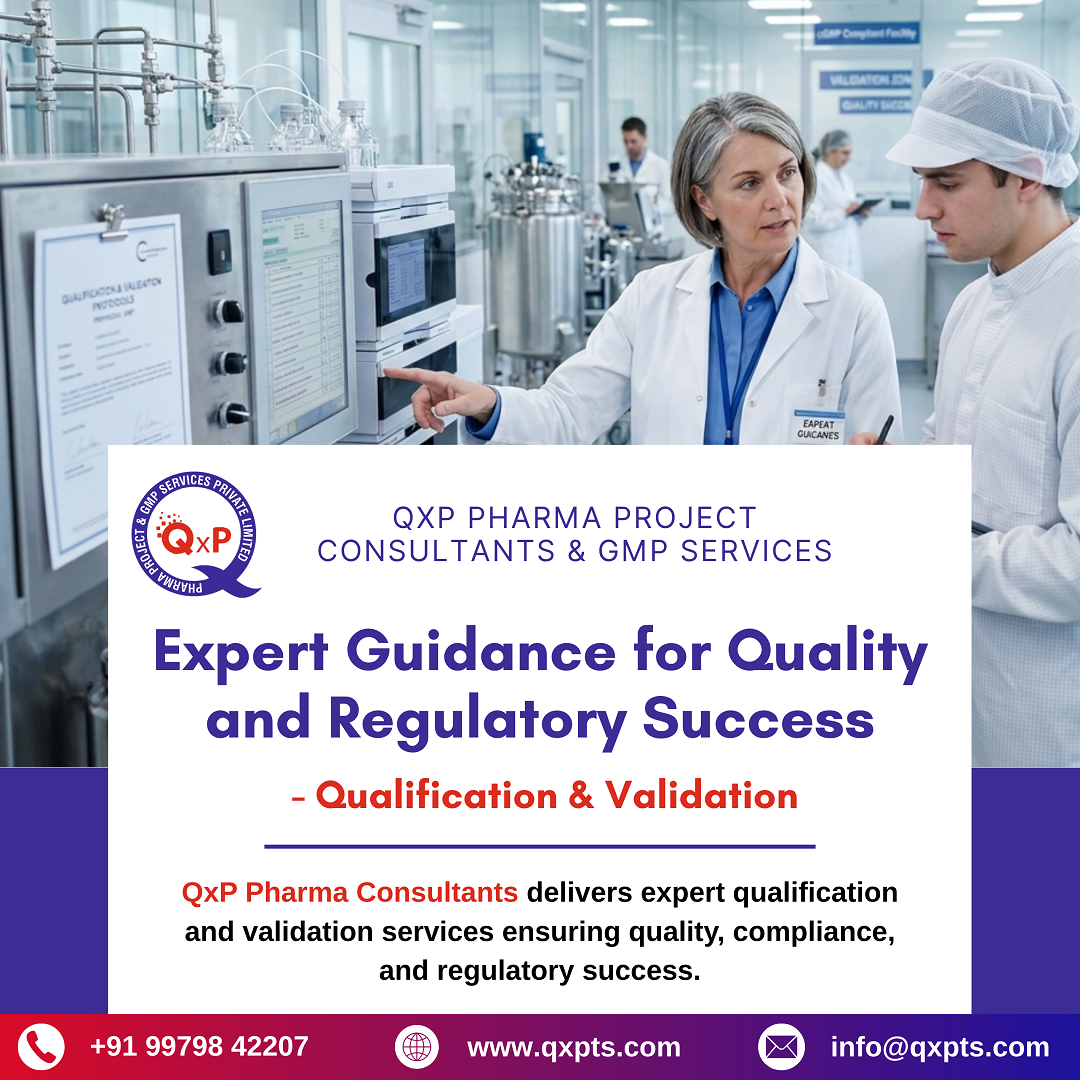
End-to-End Validation Solutions for Regulatory Success by QxP Pharma Consultant & GMP Services
Introduction: The Compliance Burden Is Real — and Growing
Running a pharmaceutical plant, a hospital, or an industrial facility today means navigating a maze of regulations that didn’t exist a decade ago. Whether you’re managing a drug manufacturing unit in Ahmedabad, overseeing a hospital expansion project in Dubai, or setting up a production line for export to Europe or the USA, the compliance expectations have never been more demanding — or more consequential when ignored.
Worker safety, machinery integrity, documentation accuracy, and legal accountability now sit at the center of every operational decision. A single audit failure can stall production for weeks. A missed validation step can lead to product recalls, regulatory penalties, or worse — patient safety incidents.
This is exactly where working with an experienced Pharma Qualification & Validation Consultant becomes not just useful, but essential.
In international project environments, what separates compliant operations from those constantly firefighting regulators is not just intention — it’s structured, documented, and expertly executed validation strategy.
The Growing Importance of Safety & Compliance in Global Industries
Regulatory bodies around the world — from India’s CDSCO and the US FDA to the European EMA, UK MHRA, and Gulf-region health authorities — are tightening their grip on pharmaceutical and industrial standards. This isn’t bureaucratic overreach; it’s a response to real-world failures and rising public expectations around product quality and worker safety.
For businesses operating across borders — exporting from India to the UAE, supplying hospitals in Saudi Arabia or Qatar, or qualifying equipment for facilities in Australia or Southeast Asia — cross-border compliance is now a commercial requirement. International buyers, insurance providers, and institutional clients increasingly demand proof of validated processes and certified safety practices before finalizing contracts.
Ignoring this reality doesn’t reduce the requirement — it only delays a crisis.
What Is a Pharma Qualification & Validation Consultant?
In practical terms, a Pharma Qualification & Validation Consultant is a technical expert or specialized firm that helps pharmaceutical manufacturers, hospitals, and industrial facilities prove — through systematic documentation and on-site testing — that their equipment, systems, processes, and environments consistently perform as intended and meet regulatory requirements.
This covers a wide range: HVAC qualification for cleanrooms, Installation Qualification (IQ), Operational Qualification (OQ), Performance Qualification (PQ), water system validation, process validation, computer system validation (CSV), and GMP compliance audits, among others.
For a pharma company CEO or CFO, the consultant’s role translates directly into reduced regulatory risk, shorter approval timelines, and operational credibility when dealing with global buyers or regulators. For a hospital administrator or engineering head, it means systems — medical gas, HVAC, sterilization — that have been verified to work safely before patients depend on them.
Our team at QXP Pharma Project Consultant & GMP Service PVT LTD delivers this across India and for international operations stretching from Oman and Afghanistan to Canada and the UK. We also have proven experience working as a Pharma Qualification & Validation Consultant in Vietnam and across Southeast Asian pharmaceutical markets.
Common Safety & Compliance Risks Across Countries
In nearly every industry — pharma, hospital, manufacturing — the same categories of risk surface repeatedly:
- Worker Safety Incidents: In facilities without structured safety protocols, injuries remain disturbingly common. This is true whether you’re managing a factory floor in India, a construction project in Tajikistan, or a pharmaceutical warehouse in Qatar.
- Machinery & Process Hazards: Unqualified equipment operating beyond its validated parameters creates both product quality risks and physical safety hazards. In pharmaceutical environments, this can directly compromise drug efficacy or sterility.
- Legal Penalties & Regulatory Shutdowns: In India, the USA, Canada, Europe, and increasingly in GCC countries, regulatory authorities have shown willingness to issue warning letters, import bans, or facility shutdowns for documentation failures — not just physical compliance breaches.
- Reputation Damage: For pharma exporters competing in the US or European markets, a single FDA 483 observation or EMA audit finding can erode months of commercial progress.
For deeper insights into SEO performance and domain authority, you can explore tools offered by Moz.
How Professional Safety Certification and Validation Reduces Risk?
The value of a qualified consultant isn’t theoretical. It’s grounded in structured, repeatable methodology.
- On-Site Assessment: Every site — whether a new GMP facility in Gujarat or a hospital in Riyadh — has unique risks. Experienced consultants identify gaps that internal teams often overlook because familiarity breeds complacency.
- Documentation That Holds Up Under Audit: Regulatory bodies in the USA, UK, and Europe look for evidence, not intention. Proper Validation Master Plans (VMP), Standard Operating Procedures (SOPs), and qualification protocols are non-negotiable in these markets.
- Alignment with Local and Global Best Practices: A validation strategy for a facility targeting the US FDA must differ from one designed primarily for Indian CDSCO submission — while still meeting global GMP expectations. Experienced consultants bridge this gap without doubling the workload.
Country-Specific Compliance Considerations
- India: The Drugs and Cosmetics Act, Schedule M GMP requirements, and CDSCO inspection protocols form the backbone of pharmaceutical compliance. Factory safety obligations under the Factories Act create parallel responsibilities for industrial and manufacturing facilities. Our team brings deep expertise as a Pharma Qualification & Validation Consultant in Himachal Pradesh and across other major Indian pharma clusters.
- Middle East (UAE, Saudi Arabia, Qatar, Oman): The Gulf region has rapidly elevated its safety and compliance expectations. Saudi Arabia’s SFDA, UAE’s MOH and MOHAP, and Qatar’s MOPH maintain progressively stricter oversight of pharmaceutical imports, hospital infrastructure, and construction project safety. Contractor compliance documentation and site safety protocols are routinely audited.
- Europe / USA / Canada / UK: These jurisdictions maintain the most rigorous audit cultures globally. Data integrity requirements, equipment lifecycle documentation, and process validation evidence must be contemporaneous, traceable, and defensible. For pharma companies exporting to these markets, validation is the passport to commercial access.
- Australia & Southeast Asia: Regulatory harmonization efforts in Southeast Asia (aligned with PIC/S standards) and Australia’s TGA requirements mean that GMP compliance standards are converging upward — not downward. Early validation investment pays dividends in smoother regulatory submissions.
- Tajikistan & Afghanistan: In emerging and transitional markets, infrastructure projects — industrial facilities, hospital builds, pharmaceutical plants — require safety frameworks that meet international standards even when local regulatory capacity is developing.
Worker Training & On-Site Safety Implementation
Validation and qualification don’t happen in documents alone. They happen through people — and that presents real challenges in multinational, multilingual work environments.
A construction project in the Gulf may employ workers from India, Pakistan, Nepal, Bangladesh, and the Philippines simultaneously. A pharmaceutical facility in Southeast Asia may have a technical team trained in one language while operating SOPs written in another.
Effective safety training in these environments requires culturally adapted communication, visual instruction methods, practical demonstration, and consistent reinforcement — not just a one-time induction session.
Staying informed with trusted sources like CNN helps businesses adapt to changing market trends.
Machinery, Equipment & Project Safety: A Global Perspective
From pharmaceutical manufacturing lines to hospital HVAC systems and industrial construction projects, equipment qualification and project safety management follow similar principles — verify, document, test, and continuously monitor.
In manufacturing, equipment qualification (IQ/OQ/PQ) ensures that machines consistently produce what they’re intended to produce, within defined parameters. For specialized guidance on Pharma CQV & CSV Consulting in Himachal Pradesh and similar industrial hubs, our team brings hands-on execution capability.
In construction and reconstruction projects — hospitals being built in Qatar, factories being expanded in India, industrial parks being developed in Oman — safety management plans protect workers, timelines, and the integrity of the finished asset.
In hospitals and critical care facilities, the stakes are highest. HVAC validation, medical gas systems, cleanroom qualification, and sterilization equipment verification directly impact patient outcomes. There is no tolerance for guesswork here.
The Role of Safety Audits, Reporting & Documentation
Audits are not obstacles — they’re verification checkpoints. When a facility’s documentation is thorough, its qualification protocols are complete, and its SOPs reflect actual practice, audits become straightforward.
The challenge is building that documentation culture before the auditor arrives. Government inspections in India, FDA pre-approval inspections in the USA, SFDA audits in Saudi Arabia — all of them reward preparedness and punish reactive improvisation.
Insurance providers increasingly require documented safety management systems as well. A facility with validated systems and certified compliance procedures carries measurably lower risk — and that translates directly into insurance terms and business continuity confidence.
Long-Term Business Value of Global Safety Certification
The return on investment in professional validation and safety certification is not abstract:
- Fewer production stoppages due to equipment failures or regulatory holds
- Faster regulatory approvals for new products or facility expansions
- Stronger negotiating position with international buyers and licensing partners
- Reduced liability exposure in worker safety incidents
- International credibility that opens doors to regulated markets
For a pharma company CFO evaluating compliance expenditure, the cost of prevention is categorically lower than the cost of remediation — particularly when remediation involves regulatory action, product recall, or facility shutdown.
What to Check Before Choosing a Safety Certification Partner?
Not every consultant brings the same depth of capability. Before committing to a partner, consider:
- International project experience — Have they delivered validation work across multiple countries and regulatory jurisdictions, not just domestically?
- Local compliance understanding — Do they understand the specific regulatory expectations in your target market, whether that’s India’s CDSCO, the UAE’s MOHAP, or the US FDA?
- On-site execution capability — Can they mobilize qualified personnel for site work, or do they operate purely as document consultants?
- Sector versatility — Do they bring experience across pharma, hospitals, and industrial projects — or only in one vertical?
Why Working with a Globally Oriented Safety Firm Matters?
When a company operates across multiple countries — sourcing from India, manufacturing in Southeast Asia, exporting to Europe, building hospitals in the Gulf — the compliance requirements don’t exist in isolation. They need to work together.
A globally oriented firm brings consistency. The same documentation standards applied in a pharma plant in Ahmedabad can be adapted — not abandoned — for a facility audit in Toronto or an equipment qualification project in Muscat.
That consistency reduces rework, accelerates regulatory timelines, and builds the kind of institutional compliance culture that regulators and clients actually trust.
QXP Pharma Project Consultant & GMP Service PVT LTD is built around exactly this approach — combining technical depth with geographic reach, serving clients across India and international markets with practical, implementable compliance solutions.
Conclusion: Safety Is a Business Strategy, Not Just a Requirement
Global industrial and pharmaceutical operations can no longer afford to treat compliance as a checkbox exercise. Worker safety, equipment reliability, and regulatory credibility are interconnected pillars of business continuity — and all three depend on rigorous, expert-led validation and certification strategy.
Whether you’re a pharma company expanding into European markets, a hospital group developing facilities in the Gulf, or a factory owner managing cross-border supply chains, the decision to invest in structured compliance is ultimately a decision to protect your workers, your operations, and your reputation.
The right partner doesn’t just help you pass an audit — they help you build a facility that doesn’t need to worry about audits.
Ready to strengthen your regulatory compliance and validation strategy? Contact our expert team today — we’re here to help you build compliant, audit-ready operations across every market you serve.
Key Takeaways
- Worker Safety: Structured qualification and safety frameworks protect personnel across all project environments — from pharma cleanrooms to industrial construction sites.
- Legal & International Compliance: Meeting regulatory expectations in India, the USA, Europe, the Gulf, and beyond requires tailored yet consistent validation strategies.
- Risk Reduction: Documented, auditable compliance significantly reduces the likelihood of regulatory penalties, production stoppages, and legal liability.
- Global Operational Confidence: Certified, validated facilities earn faster approvals, stronger buyer trust, and better insurance terms — turning compliance into competitive advantage.
Trending FAQs: Pharma Qualification & Validation Consultant
Q1. What does a Pharma Qualification & Validation Consultant actually do on-site?
- They conduct physical inspections, execute IQ/OQ/PQ protocols, review existing documentation, identify compliance gaps, and prepare audit-ready records aligned with the specific regulatory requirements of your target market.
Q2. Is validation only required for pharmaceutical companies?
- No. Hospitals, medical device manufacturers, clinical laboratories, and even industrial facilities with regulated outputs require qualification and validation activities — particularly when targeting exports or international accreditation.
Q3. How long does a typical qualification project take?
- It depends on facility size and scope. A single equipment qualification can take days; a full GMP compliance project for export readiness may require several months of structured engagement.
Q4. Does QXP Pharma serve international clients outside India?
- Yes. QXP Pharma Project Consultant & GMP Service PVT LTD works with clients across the UAE, Saudi Arabia, Qatar, Oman, Southeast Asia, and other international markets. Get in touch with our team to discuss your specific requirements.
Q5. What is the difference between qualification and validation?
- Qualification typically refers to proving that equipment and systems are installed and operate correctly (IQ, OQ, PQ). Validation extends this to prove that a process or system consistently produces results meeting predetermined specifications.
Q6. Can a consultant help us prepare specifically for US FDA or EU GMP inspections?
- Yes. Experienced consultants with international regulatory expertise can align your documentation, SOPs, and validation protocols with FDA 21 CFR Part 211, EU GMP Annex requirements, and other jurisdiction-specific standards. Explore our full range of Qualification & Validation Services to learn more.
#PharmaValidation #GMPCompliance #QualificationConsultant #RegulatorySuccess #PharmaCEO #PharmaCompliance #SafetyFirst #GlobalGMP #FDACompliance #EUGMPAudit #IndiaPharma #MiddleEastPharma #HospitalSafety #IndustrialCompliance #ValidationStrategy #QXPPharma #PharmaCFO #GulfPharma #CleanroomValidation #WorkerSafety #RegulatoryAffairs #PharmaConsultant #GMPAudit #ComplianceManagement #PharmaIndustry


Comments
Post a Comment