GMP Compliant HVAC Solutions for Pharma Facilities
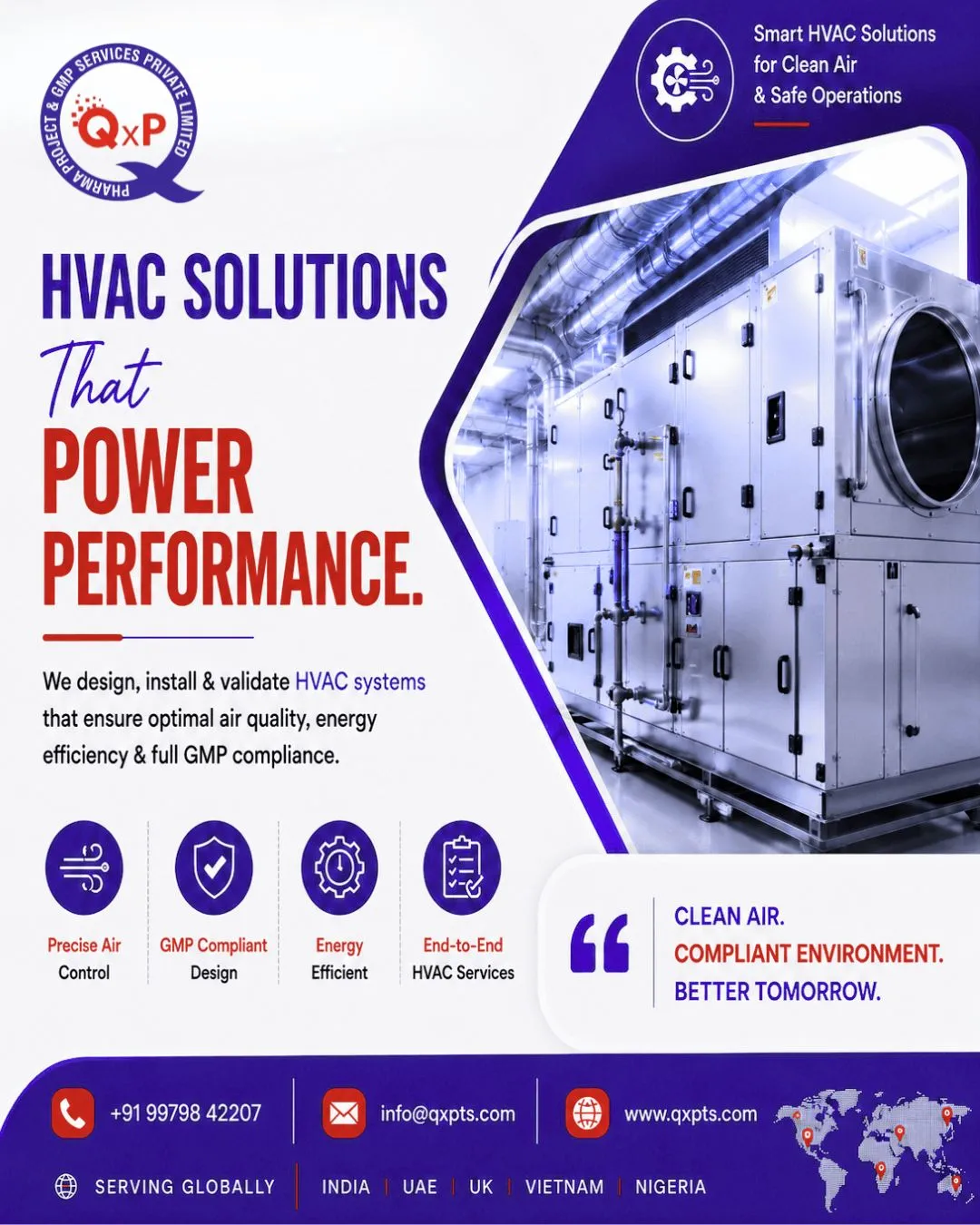
Benefits of GMP Compliant HVAC Solutions for Pharma Facilities by QxP Pharma Consultant and GMP Services
GMP Compliant HVAC Solutions for Pharma Facilities: What Every Pharma companies Must Know Before Installing If there is one technical system that can silently make or break your drug manufacturing licence — it is HVAC. A wrong air change rate, a poorly validated differential pressure cascade, or a supply air duct that bypasses a critical clean zone… any of these can trigger a WHO-GMP or CDSCO Schedule M non-conformity that no amount of papering over will fix. Over the last several years of working on pharmaceutical turnkey projects across India, one thing I have seen consistently is that promoters spend months debating the RCC structure and the utility layout — but HVAC engineering gets called in as an afterthought, sometimes just weeks before the inspection date. That is a recipe for trouble. This article is written for founders, plant heads, and project managers who want to understand GMP compliant HVAC systems not as a regulatory checkbox — but as a core investment that protects product quality, patient safety, and your entire licence.
Why Choose QxP Pharma Project & GMP Services for GMP Compliant HVAC Solutions?
Honestly, what differentiates a genuine pharma HVAC consultant from a vendor who sells AHU units is the depth of regulatory knowledge baked into the design. QxP Pharma Project & GMP Services, based in Ahmedabad and established in 2018, has been delivering end-to-end HVAC consulting as part of broader pharma turnkey project mandates — covering DQ (Design Qualification), IQ, OQ, PQ validation, and regulatory dossier preparation for CDSCO and WHO-GMP submissions.
The team is led by Mr. Pankaj Sojitra, who brings 22+ years of practical pharma project experience shop-floor exposure across oral solid dosage, sterile injectable, and API manufacturing setups. Mr. Vijay Patel, Senior GMP & Regulatory Expert with 18+ years in the field, handles the compliance and validation side, ensuring that every HVAC design maps cleanly to the applicable Schedule M requirements and WHO Technical Report Series (TRS) annexures. Together, they have led 300+ turnkey and GMP compliance projects across India.
Our GMP Compliant HVAC Consulting Capabilities
Our HVAC consulting work covers the full lifecycle — from initial concept through regulatory approval. Here is what that looks like in practice for a typical pharma manufacturing unit:
- HVAC System Design for GMP Facilities: We prepare detailed HVAC design documents including air flow schematics, room classification maps (ISO 5 through ISO 8 / Grade A–D), AHU sizing calculations, HEPA filter placement diagrams, and differential pressure cascade plans. This is not a generic design — it is developed against your specific dosage form, the CDSCO product licence category, and the applicable Schedule M clause references.
- Clean Room Design & Validation: Whether you are building an oral solids block in Pune or a sterile injectable plant in Bangalore, clean room classification and HVAC validation go together. We deliver DQ, IQ, OQ, and PQ protocols with test acceptance criteria that align with the current WHO-GMP TRS 961/Annex 6 guidance and CDSCO’s own inspection checklist requirements.
- Schedule M Compliance Review: The revised Schedule M (notified in 2023) has significantly enhanced HVAC-related requirements for pharmaceutical manufacturers. Our team helps you map your existing or proposed HVAC system against the clause-by-clause requirements — a service particularly relevant for facilities in Surat, Vadodara, and across Gujarat that are preparing for renewal inspections.
- WHO-GMP Dossier Support: For facilities targeting WHO-GMP prequalification or export-oriented manufacturing licences, HVAC documentation is scrutinised at a much higher level. We assist with technical file preparation, smoke study documentation, and room qualification reports.
- HVAC Retrofit & Upgrade Projects: Many running pharma units — especially those set up in the early 2000s in cities like Mumbai, Delhi, and Jaipur — have older HVAC systems that now need upgrades to meet revised regulatory benchmarks. We manage these retrofits without shutting down your entire facility, phasing the work around your batch schedule.
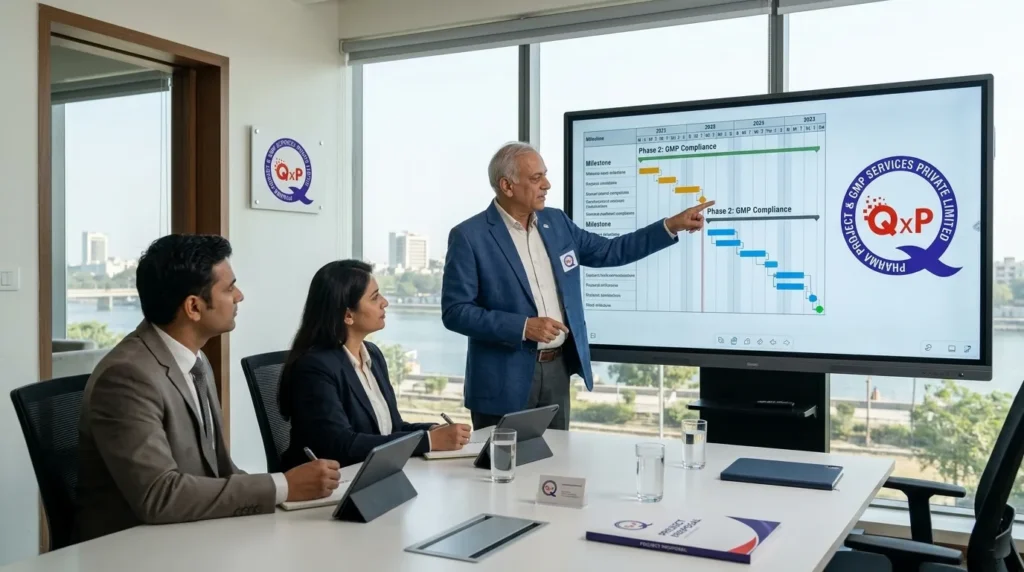
Navigating Regulatory Compliance & GMP Standards for Pharma HVAC
Regulatory compliance for pharma HVAC in India is governed by multiple overlapping frameworks, and understanding which one applies to your specific manufacturing scenario is not always straightforward. Let me break this down in plain terms.
Schedule M (Revised 2023): This is the primary Indian GMP standard under the Drugs and Cosmetics Act. Schedule M now explicitly mandates that HVAC systems in pharmaceutical manufacturing areas shall be designed, installed, qualified, and maintained to prevent contamination and cross-contamination. Key clauses address air supply quality, HEPA filtration, recirculation limits, temperature and humidity control, differential pressure documentation, and filter integrity testing protocols. Any Schedule M compliance consultant working in India today must be well-versed in the latest revision — not the older 2005 version, which is still mistakenly referenced in many project documents.
WHO-GMP Guidelines (TRS 961, 981, 992): For export-oriented manufacturers or those seeking WHO prequalification, the applicable WHO GMP guidance documents provide detailed HVAC expectations for sterile and non-sterile dosage forms. HVAC design features, qualification protocols, and ongoing monitoring programmes are all outlined. Our team regularly contributes to CDSCO and WHO-GMP guideline implementations and stays current with each new technical report series release.
CDSCO Inspection Readiness: A CDSCO approval consultant in today’s environment needs to understand that CDSCO inspectors use structured checklists derived directly from Schedule M and WHO guidelines. HVAC-related deficiencies — such as missing differential pressure records, unvalidated HVAC systems, or undocumented filter change logs — are among the most commonly cited critical and major non-conformities during GMP inspections. Our pre-inspection HVAC audit service specifically addresses this gap.
One important insight for promoters in Indore, Chandigarh, and other pharma hubs outside Gujarat: state FDA inspection timelines and depth of HVAC scrutiny can vary, but CDSCO central team inspections — particularly for Central Licence applications and WHO-GMP audits — are uniformly thorough on HVAC. Preparing adequately for the state level while being WHO-ready is the correct approach.
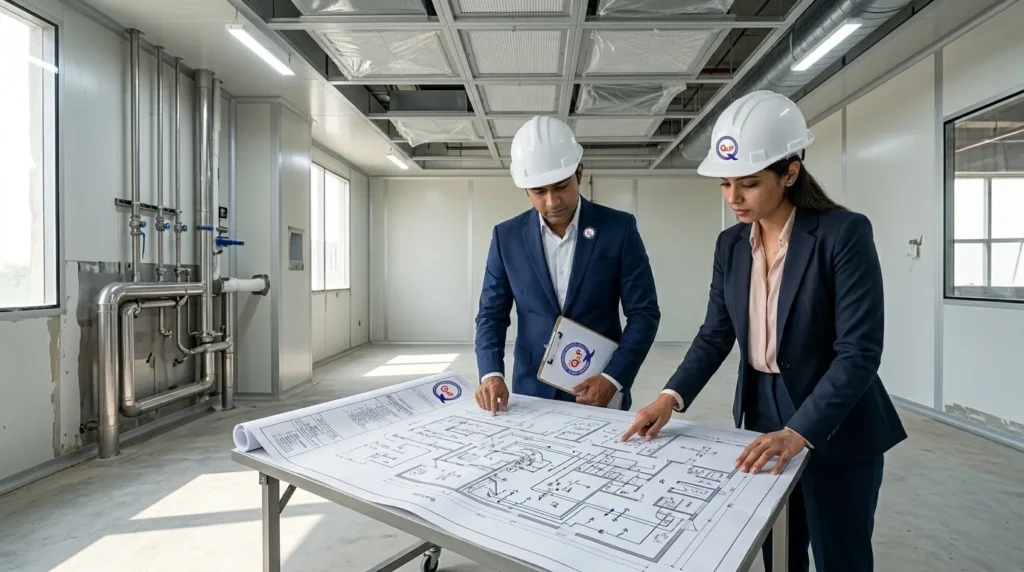
Step-by-Step Process – How We Deliver GMP Compliant HVAC Solutions?
Our process is structured to eliminate the most common sources of HVAC-related inspection failure. Here is the typical sequence for a greenfield pharma project:
Step 1 – Initial GMP Gap Assessment: Before any design work begins, we assess your current situation — existing layout drawings, product licence category, target regulatory approval (state FDA, CDSCO central, WHO-GMP), and timeline. This gap assessment forms the backbone of the HVAC design brief. Download our Free GMP Gap Assessment Checklist — WhatsApp us at +91 99798 42207 to receive it instantly.
Step 2 – HVAC Design Basis Document (DBD): We prepare a Design Basis Document covering room classification, ACH (air changes per hour) targets, temperature and RH set points, differential pressure zones, filter specifications (pre-filter, bag filter, HEPA H14), and AHU specifications. This document becomes the reference for all downstream engineering and validation work.
Step 3 – Detail Engineering & Drawing Package: Duct layout drawings, AHU GA drawings, room differential pressure schematics, and sensor/monitoring point location drawings are prepared. All drawings are stamped for GMP compliance by a qualified engineer. For a turnkey pharma plant setup near me scenario, this package integrates seamlessly with civil and utility drawings.
Step 4 – Installation Supervision: Our team provides on-site supervision during HVAC installation to catch non-conformities before they get buried in false ceilings or duct enclosures. This is especially critical for duct sealing, HEPA housing installation, and differential pressure sensor placement.
Step 5 – Commissioning & Validation (DQ/IQ/OQ/PQ): We execute the full validation lifecycle — from DQ review through PQ execution with actual particle count, air velocity, differential pressure, and HEPA integrity test data. All validation reports are formatted to meet CDSCO and WHO-GMP reviewer expectations.
Step 6 – SOP Development & Training: A validated HVAC system is only as good as the SOPs governing its daily operation. We prepare SOPs for HVAC startup/shutdown, filter change management, daily monitoring logs, and requalification scheduling. Staff training is included.
Step 7 – Inspection Support: When the CDSCO or state drug inspector arrives, our team remains available for technical clarifications on HVAC design decisions, validation data, and regulatory alignment — a service that has helped multiple clients in Kolkata and Mumbai convert potentially critical observations into minor procedural notes.
Quick Example: A GMP consultant in Ahmedabad-engaged project for a nutraceutical-to-pharmaceutical conversion unit in Ahmedabad’s Bavla industrial area involved redesigning a pre-existing HVAC system that had been installed without any regulatory design basis. Within 11 weeks, our team redesigned, re-installed, and fully validated the system — enabling the client to receive their CDSCO manufacturing licence on the first application attempt.
Get QuoteReal Client Case Study – HVAC Compliance for a Sterile Injectable Facility in Telangana
Case Study: Sunrise Lifesciences Pvt. Ltd. (Anonymised), Hyderabad, Telangana
Background: Sunrise Lifesciences (name changed) was a mid-sized injectable manufacturer in the Pashamylaram Pharma SEZ near Hyderabad. They had been operating under a state licence for small-volume parenteral (SVP) products and were now targeting WHO-GMP prequalification to supply a West African government tender. Their existing HVAC system — installed in 2015 — had no validated qualification documentation, and the differential pressure cascade in their Grade B/C corridor areas was inconsistent.
Challenge: The WHO-GMP pre-inspection consultant had flagged three critical HVAC observations: (a) absence of DQ/IQ/OQ/PQ documentation, (b) undocumented HEPA filter integrity test history, and (c) air lock pressure differentials not meeting the ≥10 Pa threshold between adjacent areas as required by WHO TRS 961.
QxP Pharma’s Approach: QxP Pharma Project & GMP Services was engaged on a fast-track basis. First, a retrospective DQ was prepared, aligning the existing system design to WHO-GMP expectations through documented risk justifications. The IQ was executed with as-built verification. For OQ/PQ, the team performed full particle count testing, room air velocity profiling, HEPA filter DOP/PAO integrity testing, and differential pressure mapping under both static and dynamic conditions — all within a 6-week window to meet the client’s tender deadline. A comprehensive HVAC technical file was produced for the WHO prequalification dossier.
Outcome: Sunrise Lifesciences successfully cleared the WHO-GMP audit with zero critical HVAC observations. Their manufacturing licence now carries WHO-GMP certification, and they executed the African government supply contract worth ₹14 crore in its first year. Download our Pharma Plant Setup Cost Guide to understand the investment involved in projects like this — WhatsApp +91 99798 42207.

FAQs:
Q1. What are GMP Compliant HVAC Solutions for Pharma Facilities?
- GMP Compliant HVAC Solutions are specialized heating, ventilation, and air conditioning systems designed to maintain clean air, temperature, humidity, and contamination control in pharmaceutical manufacturing facilities according to GMP regulations.
Q2. Why is HVAC important for pharmaceutical manufacturing facilities?
- HVAC systems help maintain controlled environments, prevent cross-contamination, ensure product quality, and support compliance with GMP, WHO, US FDA, and EU GMP guidelines.
Q3. How does a GMP compliant HVAC system improve regulatory compliance?
- A GMP compliant HVAC system provides controlled airflow, pressure differentials, filtration, and environmental monitoring, helping pharmaceutical companies meet regulatory requirements and pass inspections successfully.
Q4. What are the key components of a pharmaceutical HVAC system?
- Key components include AHUs (Air Handling Units), HEPA filters, ductwork, chillers, exhaust systems, environmental monitoring systems, and automated control systems for maintaining cleanroom conditions.
Q5. How does HVAC validation support GMP compliance?
- HVAC validation verifies that the system consistently performs according to design specifications through qualification activities such as DQ, IQ, OQ, and PQ, ensuring regulatory compliance and product safety.
Q6. What are the benefits of energy-efficient HVAC solutions in pharma facilities?
- Energy-efficient HVAC systems reduce operational costs, improve sustainability, optimize airflow management, and maintain GMP-compliant environmental conditions without compromising performance.
Q7. Why choose QxP Pharma Consultant and GMP Services for HVAC solutions?
- QxP Pharma Consultant and GMP Services provide end-to-end HVAC design, engineering, installation, qualification, validation, and regulatory compliance support tailored to pharmaceutical and healthcare facilities worldwide.


Comments
Post a Comment