Understanding Real WHO GMP Timelines
Understanding Real WHO GMP Timelines: What Pharma Founders in India Must Know Before Breaking Ground
If you have ever asked a contractor “how long will my pharma plant take to be ready?” and received a confident answer of “six months,” you already know the frustration that follows. The reality of setting up a WHO GMP-compliant pharmaceutical manufacturing unit in India is far more nuanced — and frankly, more layered — than any single timeline estimate. Between site civil work, WHO GMP facility layout planning, equipment qualification, Schedule M compliance documentation, and the final CDSCO inspection, most projects touch multiple regulatory milestones that take time, coordination, and meticulous preparation. This article breaks down what realistic GMP project timelines actually look like on the ground in India, based on over 300 project deliveries across cities like Ahmedabad, Mumbai, Hyderabad, Pune, Surat, Bangalore, and beyond.
Why QxP Pharma Project & GMP Services Approaches GMP Timelines Differently?
Most first-time pharma entrepreneurs in cities like Jaipur, Chandigarh, and Indore come to us after one of two situations: either a previous consultant gave them an overly optimistic six-to-nine-month estimate that collapsed under regulatory scrutiny, or they began construction without a proper GMP layout and are now stuck in a costly re-work loop.
QxP Pharma Project & GMP Services, led by Mr. Pankaj Sojitra (Lead Consultant with 22+ years of hands-on pharma turnkey experience) and Mr. Vijay Patel (Senior GMP & Regulatory Expert, 18+ years), was founded in 2018 with one goal: bring shop-floor reality into the planning room. The company follows ISO 9001:2015-aligned processes, actively implements CDSCO and WHO-GMP guidelines, and is an engaged member of the Indian Pharmaceutical Association (IPA).
What makes a difference? Honest timeline scoping. Every WHO GMP project has four major time-consuming layers: regulatory design approvals, civil and MEP execution, equipment installation and qualification, and documentation for licensing. Each of these runs partially in parallel — but only when planned well from day one. As a GMP plant design consultant India with real project data from 300+ assignments, the team at QxP knows exactly which phases compress and which ones cannot be rushed.
Quick Client Win: A startup pharma founder from Vadodara approached the team mid-construction because his contractor had started building an oral solid dosage area without a proper material airlock. Instead of demolishing the slab, Mr. Sojitra’s team redesigned the internal layout with minimum rework — saving approximately ₹14 lakhs and eight weeks of delay. The plant went on to receive its CDSCO manufacturing licence on the first inspection attempt.
Our WHO GMP Timeline Consulting Capabilities — Phase by Phase
Understanding WHO GMP timelines means understanding each phase and its dependencies. Here is how a realistic project unfolds for a mid-sized oral solid dosage (OSD) or liquid orals manufacturing unit in India:
Phase 1: Pre-Project Planning (Weeks 1–6)
This phase covers site selection, feasibility, GMP zoning concepts, utility planning, and a preliminary project cost estimate. Our pharma factory layout consultant team creates a GMP master plan aligned with Schedule M and WHO Technical Report Series (TRS) guidelines before a single brick is laid. Skipping this phase is the single biggest reason projects in Delhi, Kolkata, and Chennai face six-month delays later.
Phase 2: Detailed Engineering & Regulatory Design Approvals (Weeks 6–20)
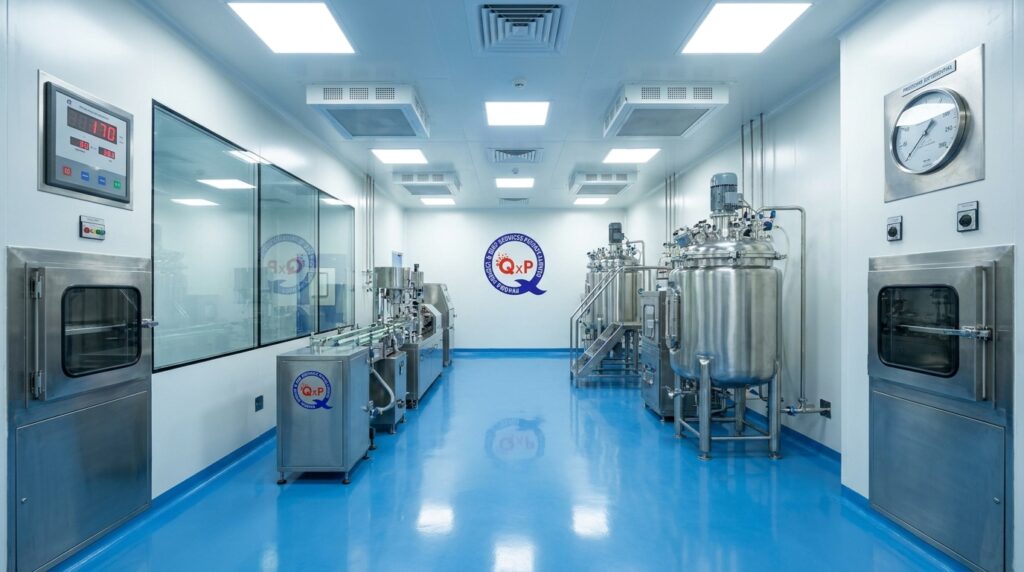
This is where clean room design consultant India expertise becomes critical. HVAC zoning, pressure differentials, air change rates, and room classification as per ISO 14644 must be designed with CDSCO approval requirements and WHO GMP TRS 961/996 in mind. In states like Gujarat, Maharashtra, and Telangana, drug authority plan approvals can take 8–14 weeks, so submitting an incomplete drawing set adds months.
Phase 3: Civil, MEP & Clean Room Construction (Weeks 12–40)
Civil and MEP work runs parallel to approvals in a well-planned project. However, clean room panel installation, HVAC duct fabrication, and utility installation (purified water, compressed air, electrical) each have their own lead times. The pharma manufacturing unit setup cost India is heavily impacted in this phase — material and labour costs vary significantly between Ahmedabad, Pune, Hyderabad, and Mumbai.
Phase 4: Equipment Procurement, Installation & Qualification (Weeks 28–52)
Equipment procurement for a turnkey pharma plant setup involves vendor qualification, FAT (Factory Acceptance Testing), delivery, installation qualification (IQ), operational qualification (OQ), and performance qualification (PQ). Importing equipment from Germany, South Korea, or China can add 12–18 weeks just for delivery. Pharmaceutical validation services for utilities and equipment cannot be fast-tracked without risking regulatory non-compliance.
Phase 5: Documentation, Mock Audits & CDSCO Licensing (Weeks 44–64)
GMP documentation — SOPs, batch manufacturing records, quality manual — must be prepared, reviewed, and trained upon before regulatory inspection. A CDSCO approval consultant with actual inspection experience knows exactly which document gaps trigger repeat visits. Our team has supported licensing in Surat, Mumbai, Bangalore, and Hyderabad with a strong first-inspection success track record.
Navigating Regulatory Compliance & GMP Standards in the Indian Context
India’s regulatory framework for pharmaceutical manufacturing draws from three primary reference pillars: Schedule M compliance under the Drugs and Cosmetics Act 1940, WHO GMP guidelines implementation (primarily WHO TRS 961, 996, and 1044), and CDSCO’s own inspection checklist framework. For export-oriented units, USFDA 21 CFR Part 211 or EU GMP Annex 1 requirements add another dimension.
A Schedule M compliance consultant working in 2025–26 must be current with the revised Schedule M notification (Gazette of India, 2023), which significantly raised the bar for documentation, HVAC standards, and quality management requirements even for small and medium manufacturers. Many plants in Indore and Chandigarh that were operating under older norms are now undergoing retrofits.
The WHO GMP framework specifically emphasises that timelines must not be compressed in ways that sacrifice qualification integrity. WHO TRS 961 Annex 9 (validation master plan guidelines) clearly states that all critical systems must complete prospective validation before commercial production begins. This is not optional, and shortcuts here are exactly what leads to import alerts and 483 observations. Our team at QxP Pharma Project & GMP Services routinely integrates WHO Technical Report Series guidelines and CDSCO inspection protocols directly into project planning timelines.
Local Consultants vs QxP Pharma Project & GMP Services — An Honest Comparison
When evaluating a pharma turnkey project consultant, here is what the decision typically comes down to in terms of timeline management, scope, and regulatory depth:
| Parameter | Typical Local/Freelance Consultant | QxP Pharma Project & GMP Services |
| Timeline Estimation | Often optimistic; rarely accounts for regulatory approval timelines | Phase-wise realistic milestones with buffer periods based on 300+ project data |
| GMP Layout Expertise | Generic floor plans; may not meet Schedule M or WHO GMP zoning requirements | WHO TRS-aligned layouts with clean room classification and pressure differential planning |
| Regulatory Support | Limited to drawing submission; no inspection preparation | End-to-end CDSCO documentation, mock audits, and first-inspection readiness |
| Validation Services | Usually outsourced or absent from scope | In-house pharmaceutical validation services (IQ/OQ/PQ, utilities, CSV) |
| Cost Transparency | Lump-sum quotes with hidden escalations | Itemised cost estimates with city-wise benchmarks and contingency planning |
| Cities Served | Typically limited to 1–2 local markets | Pan-India: Ahmedabad, Mumbai, Pune, Hyderabad, Bangalore, Chennai, Surat, Delhi, Jaipur, Kolkata, Chandigarh, Indore, Vadodara |
| Team Credentials | Varies widely; often no named regulatory expert | Mr. Pankaj Sojitra (22+ yrs) + Mr. Vijay Patel (18+ yrs); ISO 9001:2015-aligned; IPA member |
| Export Readiness | Domestic focus only | USFDA, WHO-GMP, EU GMP Annex 1 ready layouts supported |
Step-by-Step: How QxP Pharma Project & GMP Services Delivers Realistic WHO GMP Timelines
Here is how we approach a new project engagement for a turnkey pharma plant setup near me inquiry from any city in India:
- Initial Consultation & Project Brief (Week 1): We understand the product category, target market, regulatory scope (domestic / WHO-GMP export / USFDA), and site details.
- Feasibility & GMP Master Plan (Weeks 1–4): Site GMP feasibility report, preliminary layout, utility requirements, and a first-cut project budget and timeline.
- Detailed Design Package (Weeks 4–12): Complete GMP drawings — architectural, structural, HVAC, electrical, plumbing, clean room panels — submitted for drug authority approval.
- Regulatory Submission & Parallel Civil Execution (Weeks 8–30): Our GMP consultant in Ahmedabad team manages regulatory submissions while civil and MEP work begins on non-GMP areas. This parallel-track model saves 8–12 weeks on average.
- Equipment Procurement & Vendor Qualification (Weeks 16–40): Vendor shortlisting, FAT protocols, purchase order management, and delivery tracking.
- Qualification & Validation (Weeks 36–56): IQ/OQ/PQ execution for all critical systems, including HVAC, purified water, autoclave, and production equipment.
- Documentation, Training & Mock Audit (Weeks 50–62): Full SOP library, batch records, quality manual, training records, and a detailed mock CDSCO audit.
- CDSCO Inspection & Licence (Weeks 60–72): Final regulatory inspection support and manufacturing licence follow-up.
This entire cycle — for a mid-sized OSD or liquid orals unit — realistically spans 15 to 18 months from site handover to manufacturing licence. Any vendor or consultant quoting under 10 months for a full WHO GMP setup should be asked a detailed phase-wise breakdown.
Real Client Case Study: OSD Plant Setup in Hyderabad — From Ground to Licence in 17 Months
Client: Anonymised as “Sunrise Pharma Pvt. Ltd.” | Location: Hyderabad, Telangana
Background: Sunrise Pharma was a well-funded startup with a promoter from a trading background — strong on business acumen, limited on GMP execution experience. They had already spent ₹60 lakhs on civil work based on a local architect’s drawings when they reached out to QxP in early 2023. The drawings had no clean room zoning, no material/personnel airlock separation, and HVAC ducting had been routed through the dispensing area ceiling — a Schedule M non-compliance that would have failed inspection.
Intervention: Mr. Vijay Patel’s team conducted a two-day site assessment and prepared a complete GMP gap analysis report. A revised WHO GMP facility layout was prepared within three weeks, incorporating proper HVAC zoning (Class D for general OSD, Class C for coating), dedicated sampling room, dispensing suite with differential pressure, and a compliant purified water loop.
Execution: The team managed Telangana drug authority approvals (an 11-week process), coordinated three equipment vendors for tablet compression, coating, and blister packing, and ran parallel IQ/OQ/PQ validation streams. A detailed mock audit was conducted four weeks before the actual CDSCO inspection.
Outcome: Sunrise Pharma received its manufacturing licence on the first CDSCO inspection with zero major observations. Total project completion: 17 months from the revised design stage. Estimated rework cost avoided by the GMP redesign: ₹38 lakhs.
“We didn’t know what we didn’t know. The QxP team essentially re-taught us what a WHO GMP plant actually means — not just walls and machines, but a system.” — Promoter, Sunrise Pharma Pvt. Ltd.

Frequently Asked Questions About WHO GMP Timelines in India
1. How long does it typically take to achieve WHO GMP approval for a pharmaceutical manufacturing facility?
- The timeline for WHO GMP approval generally ranges from 6 to 18 months, depending on facility readiness, documentation quality, equipment qualification, validation activities, and regulatory inspection schedules.
2. What are the main factors that influence WHO GMP approval timelines?
- Key factors include facility design compliance, SOP development, equipment qualification (IQ/OQ/PQ), process validation, quality management systems, staff training, and the readiness of regulatory documentation.
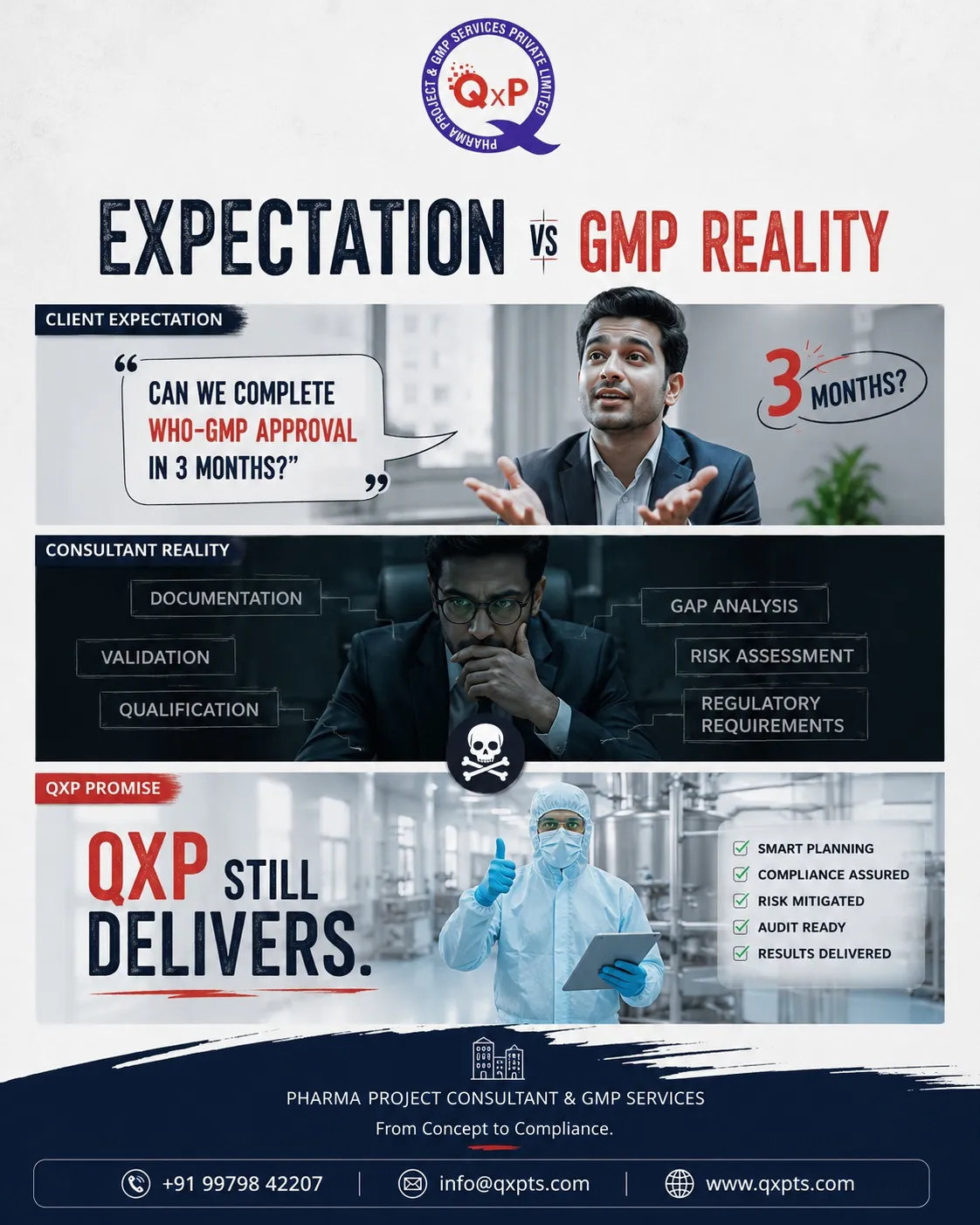
3. Can a new pharmaceutical plant obtain WHO GMP approval within three months?
- In most cases, obtaining WHO GMP approval within three months is challenging unless the facility is already fully compliant, validated, and inspection-ready. Comprehensive planning and execution are essential for faster approvals.
4. What documentation is required before applying for WHO GMP certification?
- Manufacturers typically need validation protocols and reports, SOPs, quality manuals, risk assessments, batch manufacturing records, qualification documents, and evidence of GMP compliance across operations.
5. How can pharmaceutical companies reduce delays in WHO GMP approval?
- Companies can reduce delays through early gap assessments, expert GMP consulting, proactive validation planning, regulatory readiness reviews, and continuous compliance monitoring throughout the project lifecycle.
6. Why do WHO GMP inspections sometimes result in approval delays?
- Approval delays often occur due to incomplete documentation, validation deficiencies, facility non-conformities, inadequate quality systems, unresolved observations, or delays in corrective and preventive actions (CAPA).
7. How can QxP Pharma Consultants help accelerate WHO GMP approval timelines?
- QxP Pharma Consultants supports pharmaceutical companies with GMP gap analysis, turnkey project management, validation services, documentation support, regulatory compliance strategies, and audit readiness programs to help achieve timely approvals.
8.What is the realistic WHO GMP approval timeline?
- A realistic WHO GMP approval timeline ranges from 6 to 18 months, depending on facility readiness, validation status, documentation completeness, regulatory requirements, and inspection outcomes. Proper planning and GMP compliance significantly improve approval success and reduce delays.


Comments
Post a Comment